Why choose LCACHECK?
With extensive international experience in Life Cycle Assessment (LCA), Product Carbon Footprints (PCFs), and Environmental Product Declarations (EPDs), LCACHECK provides technically rigorous and practical sustainability solutions tailored to each client’s needs.
Transparent and reliable approach
Flexible and client-oriented collaboration
Fast response times and timely delivery
Continuous support throughout the project
Direct communication and technical guidance


The Life Cycle Assessment methodology
The Life Cycle Assessment (LCA) methodology is a scientific and internationally recognized approach used to evaluate the environmental impacts associated with a product, process, or service throughout its entire life cycle. This includes all stages from raw material extraction and manufacturing to distribution, use, and end-of-life treatment. By identifying environmental hotspots across the value chain, LCA supports informed decision-making and the development of more sustainable products and systems.
LCA studies are commonly developed in accordance with the ISO 14040 and ISO 14044 standards, which establish the principles, framework, requirements, and guidelines for conducting robust and transparent assessments. The methodology is widely applied in sustainability strategies, environmental product declarations (EPDs), carbon footprint studies, eco-design, and regulatory compliance, helping organizations quantify and reduce their environmental impacts.


Environmental Product Declarations
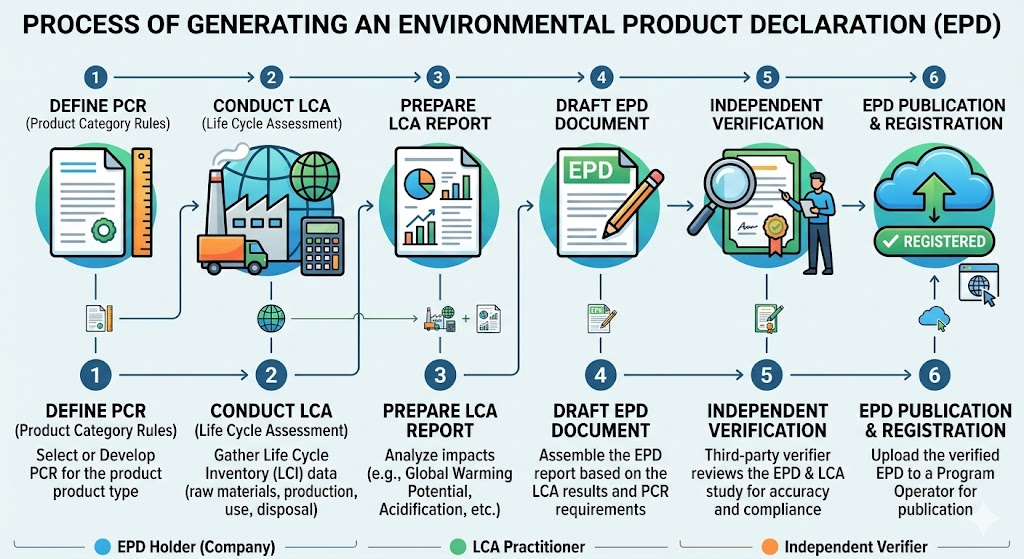
Environmental Product Declarations (EPDs) are standardized and independently verified documents that communicate the environmental performance of products based on Life Cycle Assessment (LCA) methodology. Developed in accordance with international standards such as ISO 14025 and EN 15804, EPDs provide transparent, comparable, and science-based environmental information covering the entire life cycle of a product.
EPDs are widely used to support sustainable procurement, green building certifications, regulatory compliance, and corporate sustainability strategies. By providing credible environmental data, they help manufacturers, designers, and customers make informed decisions while demonstrating a company’s commitment to transparency and environmental responsibility